
there are 8 million stories of esu,
this is just one of them
Detective Michael Corr, ESU (Ret.)
click here for PAST STORIES
The 14th street subway disaster
August 28, 1991
At precisely 11:38 p.m. on August 27, 1991, a southbound No. 4 IRT Lexington Avenue train pulled out of the Woodlawn station in the Bronx, beginning its routine overnight run through Manhattan and into Brooklyn. The ten-car R-62 train was operated by motorman Robert E. Ray.
Ray had reported late for his shift—fifteen minutes behind schedule, disheveled and out of uniform. Despite this, he was permitted to take control of the train. As a result, the southbound No. 4 departed Woodlawn six minutes late.
The No. 4 line is one of New York City’s busiest routes, carrying thousands along the east side of Manhattan each day. At that late hour, however, passenger volume was lighter than during peak periods. Among those boarding at Woodlawn was Steve Darden, an off-duty Transit Authority conductor heading home after finishing his shift.
The first stop was Mosholu Parkway, another elevated station. When the train came to a halt, Darden immediately noticed something was wrong. The motorman had overrun the platform by five cars. When the doors opened, passengers in the first five cars stepped not onto a platform—but looked into darkness of the tracks and the street below.
Alarmed, Darden went in search of the on-duty conductor, David Beerram. He found him as the train approached Bedford Park. Again, Ray overshot the station—this time by one car. Darden and Beerram contacted the motorman via the intercom. Ray assured them he was fine. Beerram admonished him and warned him to be careful. The train continued south.
For a short time after being confronted, Ray operated the train below normal speed. But the restraint did not last.
Shortly after midnight, the train descended from the elevated line into the underground tunnels of Manhattan. Between stations, Ray gradually increased speed. After leaving 42nd Street–Grand Central, he accelerated aggressively—eventually exceeding 50 miles per hour.
Ahead lay a construction zone on the express track. The train was required to slow to 10 miles per hour and divert to the local track via a switch near 14th Street–Union Square.
At approximately 12:12 a.m.—just 34 minutes after departing Woodlawn—the train entered the switch block at more than five times the authorized speed.
What happened next unfolded in seconds.
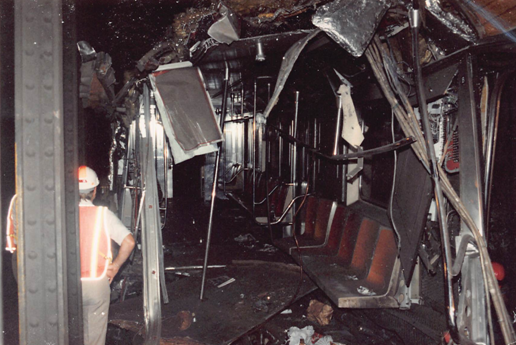
Car No. 1440 derailed, slammed into a steel support pillar, and was ripped apart—its roof sheared off; its body cut in half. The second car, No. 1439, folded inward and became wedged between the support columns separating the express and local tracks. The third car, No. 1437, split and wrapped around another steel beam. Cars four and five suffered catastrophic structural damage. Only the rear five cars remained largely intact.
The tunnel filled with smoke, dust, and screams.
initial response
Transit Police maintained a command post inside the Union Square station. Two officers on duty heard what sounded like an explosion. Entering the northbound tunnel to investigate, they encountered devastation roughly 100 yards inside—twisted steel, mangled cars, and injured passengers trapped in darkness.
They immediately called for assistance.
Citywide, the midnight shift had just begun. Staffing levels were at their lowest, as is typical during overnight hours—particularly in late summer. At approximately 12:25 a.m., the first radio transmission went out: a train derailment at 14th Street with possible injuries.
Initially Manhattan based Emergency Service Unit (ESU) were assigned. ESU officers from Truck 2, returning from overtime in Brooklyn’s 70th Precinct, self-dispatched and became the first ESU personnel to arrive. After entering the tunnel and assessing the magnitude of the disaster, they urgently requested all available ESU units citywide.
The rescue
Inside the wreckage, victims lay entangled in razor-sharp sheet metal and splintered steel. Some were clearly deceased. Others were gravely injured. A few initially believed dead were later discovered to be alive.
Stainless steel grab poles—normally used by passengers for balance—had been twisted and wrapped around bodies. They were nearly impossible to move and extremely difficult to cut.
The derailment had also destroyed critical structural support columns. Twenty-three steel columns supporting the street above were either knocked out entirely or severely compromised. Recognizing the danger of a possible street collapse, the first ESU officers immediately ordered patrol units to divert all vehicle traffic above the crash site—including Fire and EMS apparatus. That quick thinking likely prevented an even greater catastrophe.
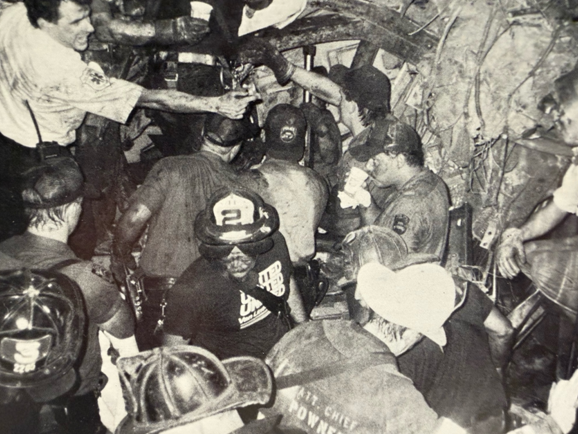
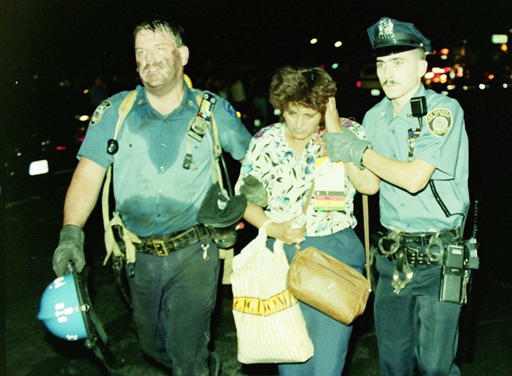
As more ESU officers arrived, they fanned out through the multiple wrecked cars finding dozens of injured victims throughout the cars and on the tracks including bodies on top of the train. Eight people were pinned in the wreckage and required specialized extrication tools to remove them. For the next four hours teams of ESU officers along with FDNY Rescue units and EMS teams worked to stabilize then remove the victims.
Perhaps the most difficult and prolonged rescue was that of Steve Darden, the off-duty conductor who tried to stop the motorman’s reckless operation of the train. For four hours rescuers worked feverously to free him all while trying to keep him alive.
environmental hazards
Lower Manhattan’s IRT tunnels lack modern ventilation systems. Airflow depends largely on passing trains creating a vacuum effect. With train service halted, the air became stagnant.
Hydraulic rescue tools were needed to free trapped passengers. Generators needed to supply power and lighting as well as cutting tools and saws were employed to free the trapped victims. Many were gasoline-powered, including Hurst rescue tools. As multiple tools roared to life simultaneously, carbon monoxide levels rose dangerously in the confined space.
Temperatures inside the tunnel reportedly reached 110 degrees. The heat was oppressive. The noise from saws and cutters was deafening, making verbal communication nearly impossible.
Two ESU officers on scene were also certified Physician Assistants. While tending to injured passengers, they also monitored fellow rescuers—ensuring hydration, rotation, and medical evaluation. Despite those efforts, more than two dozen rescuers suffered heat exhaustion or carbon monoxide exposure during the four-hour extrication.
Compounding the chaos, the train’s impact ruptured a large grease reservoir that lubricated the track switch. Thick black grease spilled throughout the first car and across the tracks, coating surfaces and making footing treacherous.
The motorman
As investigators searched for the operator, Transit Police initially encountered Robert Ray on the 14th Street platform. When asked if he was injured, he replied that he was fine. Officers rushed past him into the tunnel to assist victims.
Ray walked out of the station.
He purchased several beers and sat in Union Square Park, drinking while watching the massive emergency response to the disaster he had caused.
Nearly four hours later, he was located near his Bronx home and arrested. Ray’s blood alcohol level was twice the legal limit
The toll
Approximately 200 passengers were believed to be aboard the train.
- 138 were transported to 12 area hospitals
- 20 were admitted
- 34 were treated at the scene
- 5 passengers died
In addition, 35 rescuers were treated for carbon monoxide exposure or heat exhaustion.
Most of the seriously injured passengers had been riding in the first four cars.
aftermath
On October 15, 1992, a Manhattan jury convicted Robert E. Ray of five counts of manslaughter and 15 counts of assault. Prosecutors had argued for second-degree murder, contending that Ray acted with “depraved indifference” by operating the train while intoxicated.
The jury concluded that while his conduct was not depraved indifference murder, it did constitute reckless disregard for human life.
Ray was sentenced to a term of five to fifteen years. He ultimately served ten years in prison and was released in April 2002.
Conductor David Beerram, who was in-charge of the train was fired for not stopping the train and removing Ray from duty.
Steve Darden, the off-duty conductor who was returning home and who tried to stop Ray from his reckless operation of the train was critically injured in the accident. After a four-hour extrication, he was the last victim to be pulled alive from the wreckage. Unfortunately, after numerous surgeries surgeons were unable to save his arm.
The crash led to major changes in the safety policies of the Transit Authority, and the start of random drug testing for bus drivers, subway motorman and conductors.
epilogue
Karma: fate or destiny resulting from one’s previous actions.
On May 28, 2015, a 62-year-old man attempted to cross the Grand Concourse at 182nd Street in the Bronx. Witnesses stated he appeared intoxicated. He stumbled into oncoming traffic and was struck by a vehicle that fled the scene.
As he lay critically injured in the street with multiple fractures, he could undoubtedly hear and feel the vibration of the D train passing beneath him into the 182nd Street station.
Responding officers from the 46th Precinct and EMS transported him to Bronx Lebanon Hospital in critical condition.
The injured pedestrian was identified as Robert E. Ray, former New York City Transit Authority motorman.
Comments
That was a tough job coming back to Manhattan from Crown Heights. Unbelievable effort by all who were on the scene.
Great recap Mike! You brought up a few details that I was unaware of. Good work!
Great story Mike, that was a big job. You’d make a great author for a book about ESU and its history.
That was a long tough night, I don’t know how many of us were in the park, but we were right there,
Outstanding article Mike ! You should compile these stories into a book. It would be a best seller.